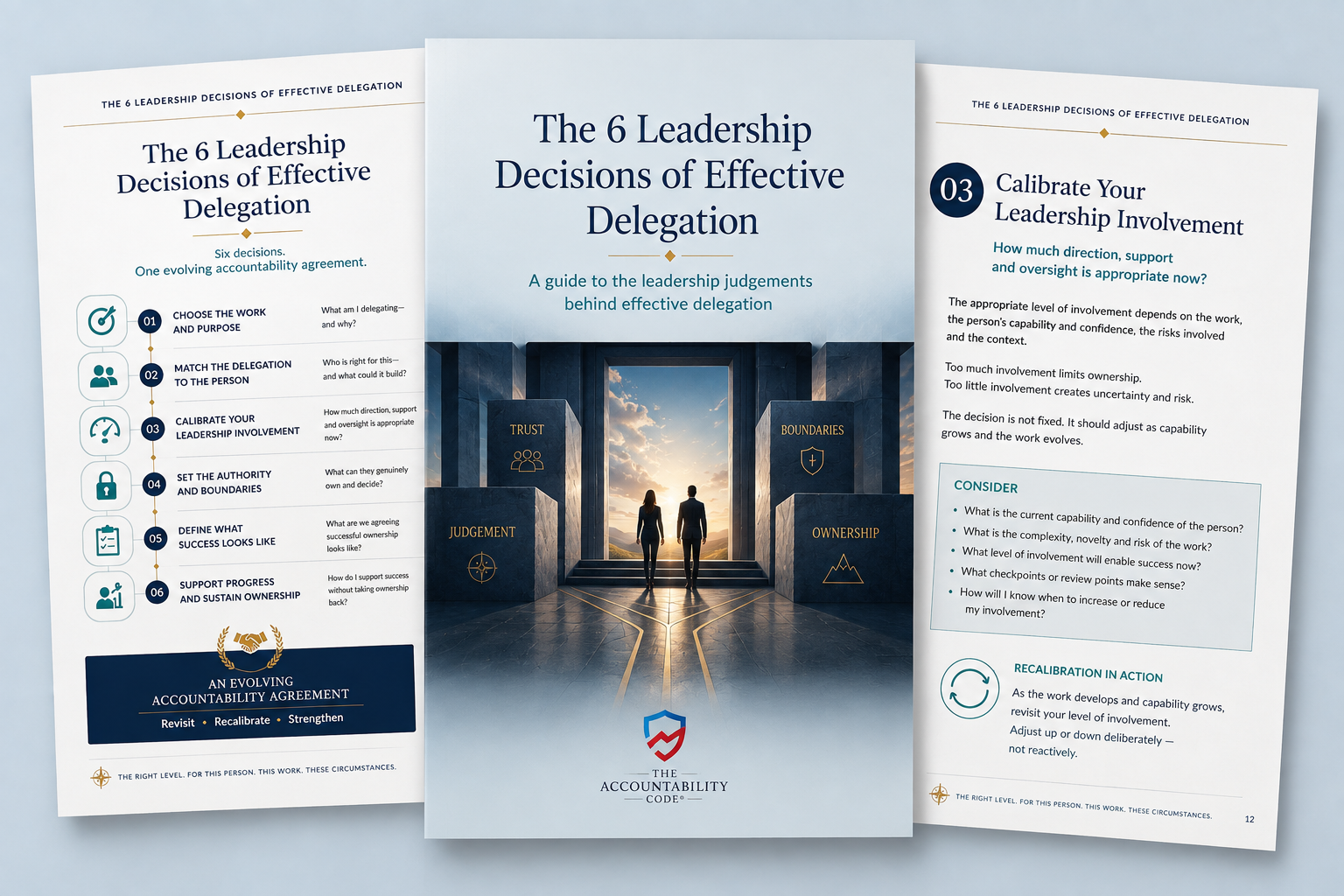
Delegation Is Not a One-Time Event. It Is an Evolving Accountability Agreement.
Delegation Is Not a One-Time Event. It Is an Evolving Accountability Agreement.
When the agreement exists mostly in people’s heads
Leaders often confuse trust with telepathy
When ownership begins to drift
Accountability deteriorates when the agreement changes silently
Oversight belongs inside delegation
An agreement that can evolve with the work
Put an Accountability Agreement into practice with these resources
Synopsis
Delegation does not end when the work changes hands. As circumstances shift, so can expectations, authority and ownership—often without anyone noticing. An evolving accountability agreement keeps delegation working without allowing oversight to become control.
Introduction
Delegation is often described as a handover.
A leader identifies the work, selects someone to do it, explains what is required and steps away. In theory, responsibility has moved.
In practice, that is often the moment the real work of delegation begins.
Circumstances change. New information emerges. Capability develops. Risks become clearer. Priorities shift. Questions arise that neither person anticipated in the original conversation. Somewhere along the way, the agreement the leader thought they made may no longer be the agreement people are actually working to.
I have seen this play out repeatedly, including in my own work.
One version appears surprisingly often in complex change environments. An executive brings in an experienced change specialist and says, in effect, “I want you to do the change management.”
At face value, it can sound like excellent delegation. An expert has been appointed and given room to work. They can assess what is needed, shape an approach and bring specialist knowledge to a problem that sits outside the executive’s own expertise.
But there is an important difference between bringing in expertise and handing over responsibility for something the leader still has to lead.
In one situation I experienced, the distinction was almost impossible to establish because meaningful access to the executive was difficult from the outset. Change was seen as something the specialist had been brought in to handle. When deeper engagement was needed to explore what the organisation was actually trying to achieve, the response was essentially: “that is what you are being paid to work out”.
Handing work to an expert and stepping away can look like trust. In reality, it can leave them with enormous freedom over how they work yet no reliable way of knowing whether they are solving the right problem.
A specialist can analyse, advise, facilitate and design. They can bring experience the executive does not possess. What they cannot independently determine is what sits inside the leader’s head: which outcomes matter most, what the organisation is prepared to change, where the boundaries lie, what trade-offs are acceptable, or how much executive ownership will be available when the work reaches people and begins to affect behaviour.
Those things have to come into the relationship somehow.
When they do not, the person receiving the work starts operating inside an agreement that exists largely through inference.
When the agreement exists mostly in people’s heads
The first signs of poor delegation are not always dramatic. In fact, the early stages can feel quite normal.
The work begins. Progress is made. The person who has been given responsibility uses their judgement and gets on with it. If they are experienced, they will naturally fill some gaps themselves. That is part of what expertise is for.
The difficulty comes when the gaps concern matters that expertise cannot resolve.
In the change assignment, communication with the executive moved largely through a project manager. At one point a suggestion came back that reporting might need to happen more frequently. That sounded reasonable enough, but it immediately raised a more important question: reporting on what?
A request for greater visibility only becomes useful when both people understand what needs to be visible and why. More reporting does not repair an unclear outcome. It does not reveal expectations that have never been articulated. It can simply create more information around an uncertainty that remains unresolved.
That distinction matters because an experienced person inside such a situation may not immediately conclude that the structure around the work is failing. Their first instinct is often to examine their own performance. Perhaps the analysis needs strengthening. Perhaps the executive needs different information. Perhaps something has been misunderstood.
A capable person can begin working harder against a problem that cannot be solved from their side of the relationship alone.
They may also begin questioning themselves. That is one of the more damaging consequences of unclear delegation because it is easy to interpret the absence of useful feedback as evidence of inadequate performance. Yet no amount of professional competence can reliably satisfy expectations that remain inaccessible.
Leaders often confuse trust with telepathy
This phrase is deliberately provocative because it’s where apparently generous delegation can become deeply unfair. The leader believes they have provided autonomy. The person receiving the work is expected to exercise. But judgement still needs something to work from. It needs an outcome, context and enough access to test assumptions before those assumptions become expensive.
This is not an argument for leaders to prescribe every detail. Quite the opposite. The more experienced the person receiving the work, the less likely they are to need instruction about method. What they still need is an accountability relationship robust enough to support independent judgement.
The distinction is easy to miss.
A leader can give someone enormous freedom over how they work while leaving them almost no reliable way of knowing whether they are solving the right problem.
When ownership begins to drift
The change assignment also illustrates another feature of delegation that is easy to overlook: ownership does not always move in one clean direction.
It may begin with genuine room to operate. Then circumstances start exerting pressure on the original arrangement.
In this case, reporting expectations became less certain and communication remained indirect. Eventually another senior person indicated that they would take over the change work themselves. There had been no substantive conversation with the person who had originally been given responsibility about what was changing, what was causing concern, or whether a different arrangement was now required.
By then, the practical ownership of the work was already shifting.
This is where delegation becomes far more interesting than the simple idea of “letting go”. Work does not remain static after it has been handed over. Its risk can change. Senior attention can increase. New information can expose weaknesses in the original assumptions. A leader who was comfortable with the level of independence at the beginning may quite reasonably need to become more involved later.
There is nothing inherently wrong with that. The mistake is allowing the change to occur without bringing it back into the agreement.
One person can still be working as though the original authority stands while the leader has already begun making decisions again. Neither has necessarily said that the delegation has changed, yet in practice it has.
Accountability deteriorates when the agreement changes silently
That is one reason delegation cannot be understood as a single conversation at the beginning of the work.
The original agreement may have been entirely appropriate. What matters is whether it remains appropriate as the work develops.
In the situation I have described, the final judgement was that delivery had not met expectations. Yet the expectations themselves had never become sufficiently available to shape the work. The person doing it had been asked to exercise expertise inside a relationship that provided limited access to the people whose expectations ultimately mattered.
The point is larger than this particular experience, and larger than change management.
Whenever a leader delegates complex work, both parties are making assumptions about authority, visibility, involvement and results. Some will prove correct. Others will not survive contact with reality. The quality of delegation depends partly on whether those assumptions can be surfaced while there is still time to do something useful with them.
Oversight belongs inside delegation
This also changes the way we think about oversight.
Leaders who are wary of micromanagement can sometimes conclude that good delegation means leaving people alone. Leaders who are anxious about results can reach the opposite conclusion and remain so close to the work that meaningful ownership never develops.
Neither position gets us very far.
Useful oversight is part of the original accountability relationship. If a leader knows that a piece of work carries significant risk, there is nothing inherently controlling about wanting regular visibility. The same may be true when someone is developing capability or when the work is moving through an unfamiliar environment.
The difference lies in whether that visibility has a purpose understood by both people.
A planned conversation about progress feels very different from the leader suddenly appearing because their anxiety has risen. One allows the person doing the work to prepare, raise issues and use the conversation intelligently. The other can feel like an inspection.
A checkpoint should not be an ambush initiated after a leader becomes anxious.
When a checkpoint is part of the agreement from the beginning, it can be used to examine whether anything important has changed. The conversation may reveal that the original authority still works perfectly well. It may also reveal that the work has become more complex than either person expected and that a different level of involvement is now sensible.
What matters is that oversight does not quietly become reclamation.
This is particularly important because leaders teach people what ownership really means through what happens after they delegate. If independent decisions are routinely overridden because they differ from the leader’s preference, the formal delegation begins to mean very little.
People learn where the real authority sits by watching what happens when they actually use the authority they were given.
The reverse is equally problematic. A leader who disappears whenever uncertainty arises teaches people that ownership means carrying ambiguity alone.
Good delegation requires something more mature than either withdrawal or control. The leader remains present in the accountability relationship without needing to remain inside every action.
An agreement that can evolve with the work
This is why I have come to think of delegation as an evolving accountability agreement.
The idea of an agreement shifts the emphasis away from simply assigning activity. It asks whether there is enough shared understanding for another person to exercise judgement with confidence. The leader does not need to anticipate every eventuality, and in complex work that would be impossible anyway. They do need enough clarity between them that new circumstances can be discussed rather than guessed at.
The word evolving matters just as much.
The person receiving the work may become more capable and need greater latitude. A task that appeared low-risk may become politically sensitive. A stakeholder may introduce a constraint nobody anticipated. The original outcome may even need to be reconsidered.
None of this means the delegation has failed. It means reality has entered the picture.
At that point, leaders often have more choices than they initially realise. Increased involvement does not automatically require taking the work back. A conversation may be enough to restore clarity. The person doing the work may need better access, a different decision boundary, or a clearer understanding of what the leader now needs to see.
The important thing is that the relationship catches up with the work.
That is where the idea of delegation as a one-time event becomes inadequate. It encourages leaders to judge success by what happened at the moment of handover: Was I clear? Did they agree? Did I step back?
Those are useful questions, but they belong to the beginning.
As the work unfolds, a different question becomes much more revealing:
Is the accountability agreement still clear, current and owned by the right person?
If the answer has become uncertain, the task is not necessarily to step in and take control. Nor is it to step farther away in the hope that autonomy will somehow resolve the ambiguity.
It is to bring the agreement back into the conversation.
Because the most damaging delegation failures are not always created by a leader who refuses to let go. Some begin with a leader who believes they already have.
Put an Accountability Agreement into practice with these resources